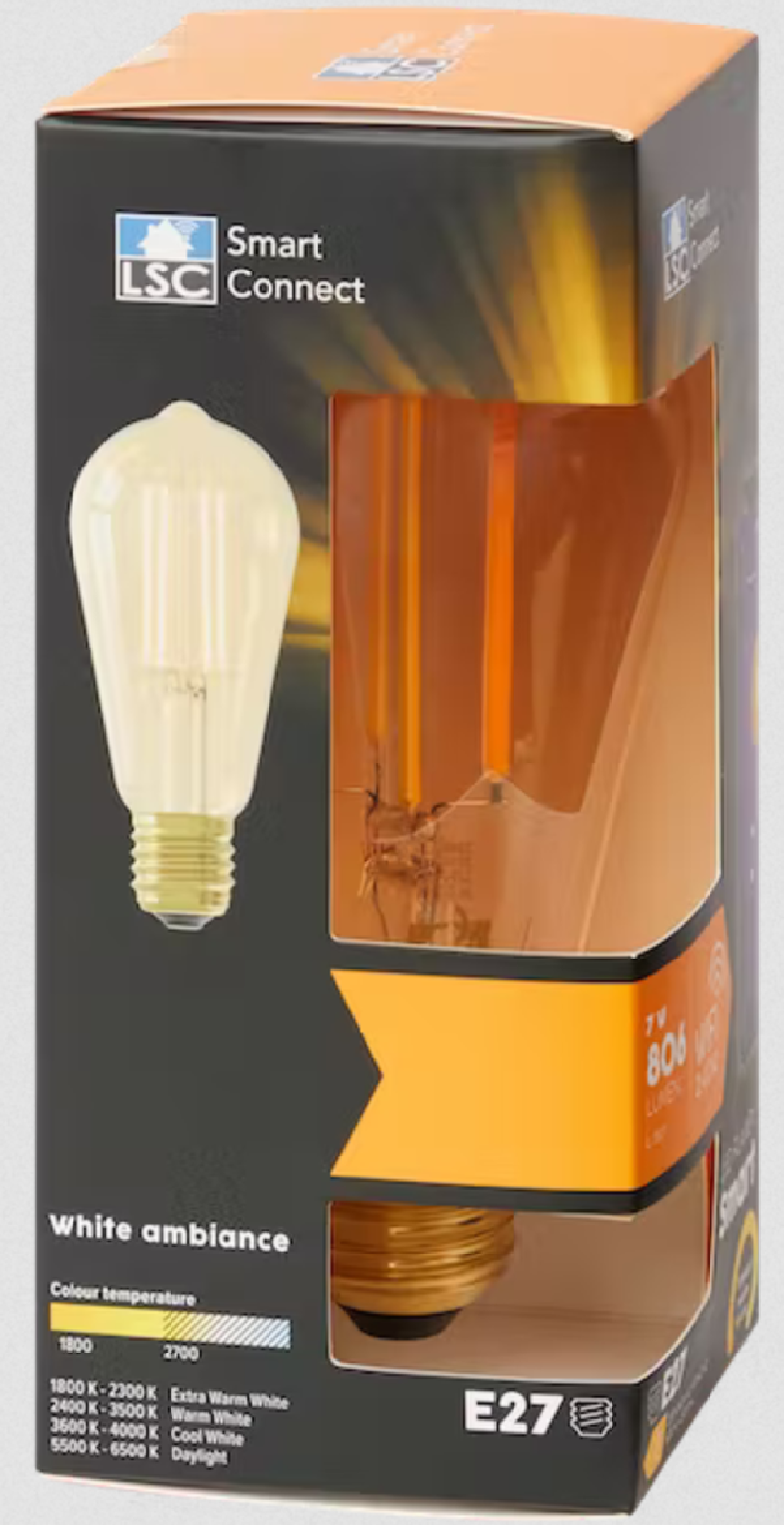
LSC Led Filament Smart 3200074
Warning
The latest LSC Light Led Filament Smart 3200074 devices use the Tuya BK7231T module, which is not compatible with ESPHome!
Notice
- This light is flashable using the latest tuya-cloudcutter with a compiled ESPHome binary.
- The LEDs are controlled by 2 PWM output (Cold and White channels).
- The PWM are ingested into a BP5772 chip (Tuya).
- Note that in this device, the cold and warm outputs are inverted compared with the LSC White Ambiance 3000272.
Product Images
GPIO Pinout
| Pin | Function |
|---|---|
| P26 | Cold White (PWM) |
| P24 | Warm White (PWM) |
Basic configuration
#

## Transparent glass

#

## cold and warm colors are different from the white glass

substitutions:
  name: lsc-light-warm-04
  friendly_name: lsc-light-warm-04
esphome:
  name: ${name}
  friendly_name: ${friendly_name}
libretuya:
  board: generic-bk7231t-qfn32-tuya
  framework:
    version: dev
# Enable logging
logger:
# Enable Home Assistant API
api:
  encryption:
    key: !secret enc_key
ota:
  password: !secret ota_password
wifi:
  ssid: !secret wifi_ssid
  password: !secret wifi_password
  # Enable fallback hotspot in case wifi connection fails
  ap:
    ssid: "Lsc-Light-Warm-01"
    password: !secret ap_password
#web_server:
#  port: 80
sensor:
  - platform: wifi_signal
    name: "WiFi Signal Sensor"
    update_interval: 60s
  - platform: uptime
    name: Uptime Sensor
    id: uptime_sensor
    update_interval: 60s
    on_raw_value:
      then:
        - text_sensor.template.publish:
            id: uptime_human
            state: !lambda |-
              int seconds = round(id(uptime_sensor).raw_state);
              int days = seconds / (24 * 3600);
              seconds = seconds % (24 * 3600);
              int hours = seconds / 3600;
              seconds = seconds % 3600;
              int minutes = seconds /  60;
              seconds = seconds % 60;
              return (
                (days ? to_string(days) + "d " : "") +
                (hours ? to_string(hours) + "h " : "") +
                (minutes ? to_string(minutes) + "m " : "") +
                (to_string(seconds) + "s")
              ).c_str();
text_sensor:
  - platform: template
    name: Uptime Human Readable
    id: uptime_human
    icon: mdi:clock-start
  - platform: wifi_info
    ip_address:
      name: IP Address
      entity_category: diagnostic
binary_sensor:
  - platform: status
    name: Status
    entity_category: diagnostic
button:
  - platform: restart
    id: restart_button
    name: Restart
    entity_category: diagnostic
output:
  - platform: ledc
    id: output_cold_white
    pin: P26
  - platform: ledc
    id: output_warm_white
    pin: P24
# Example configuration entry
light:
  - platform: cwww
    name: ${friendly_name}
    id: the_light
    cold_white: output_cold_white
    warm_white: output_warm_white
    cold_white_color_temperature: 2736 K
    warm_white_color_temperature: 1800 K
    constant_brightness: true
    effects:
      - random:
          name: "Slow Random"
          transition_length: 30s
          update_interval: 30s
      - random:
          name: "Fast Random"
          transition_length: 4s
          update_interval: 5s
      - strobe:
      - flicker:
          alpha: 50% #The percentage that the last color value should affect the light. More or less the “forget-factor” of an exponential moving average. Defaults to 95%.
          intensity: 50% #The intensity of the flickering, basically the maximum amplitude of the random offsets. Defaults to 1.5%.
      - lambda:
          name: Throb
          update_interval: 1s
          lambda: |-
            static int state = 0;
            auto call = id(the_light).turn_on();
            // Transtion of 1000ms = 1s
            call.set_transition_length(1000);
            if (state == 0) {
              call.set_brightness(1.0);
            } else {
              call.set_brightness(0.01);
            }
            call.perform();
            state += 1;
            if (state == 2)
              state = 0;

## Blink the light if we aren't connected to WiFi.

## Uncomment below

#interval:
#- interval: 500ms
#  then:
#  - if:
#      condition:
#        not:
#          wifi.connected:
#      then:
#        - light.turn_on:
#            id: the_light
#            brightness: 50%
#            transition_length: 0s
#        - delay: 250ms
#        - light.turn_off:
#            id: the_light
#            transition_length: 250ms